
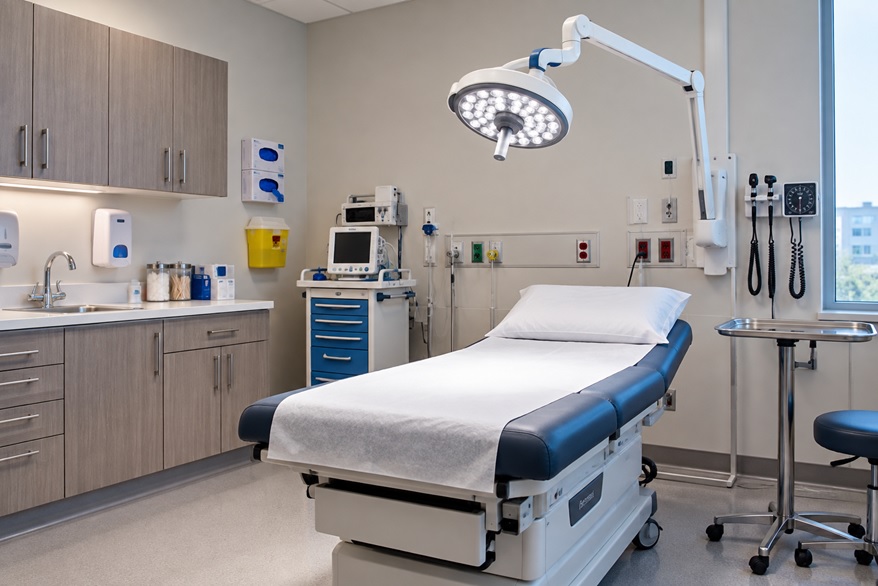

Examination lighting is an important part of clinical workspace planning. In hospitals, outpatient clinics, treatment areas, and procedure rooms, lighting must support clear visibility while fitting naturally into the way healthcare professionals work.
For facility managers, procurement teams, and clinical engineering professionals, selecting hospital exam lights involves more than comparing brightness levels or fixture styles. The equipment needs to suit the room, the procedures performed there, staff positioning, cleaning requirements, and long-term maintenance expectations.
Evaluating these factors together can help healthcare facilities select lighting that supports both clinical performance and efficient room operation.
Begin With the Clinical Tasks Performed in the Room
The appropriate lighting configuration depends heavily on how the room will be used. A general examination room may have different requirements from a dermatology clinic, minor procedure room, emergency department treatment space, or specialized outpatient environment.
Facilities should begin by identifying the types of examinations and procedures performed most frequently. This helps determine the level of illumination, positioning flexibility, and coverage required.
For routine examinations, clinicians may need focused lighting that can be moved quickly between different areas of the patient. Procedure lighting may require greater illumination consistency and more precise positioning, particularly when clinicians are working within a smaller treatment area.
It is also useful to consider how often the light will be repositioned during a typical appointment. Equipment that is suitable for a fixed examination position may be less effective in a room where clinicians regularly change working angles or move around the treatment table.
Understanding these clinical tasks first provides a more reliable basis for evaluating lighting specifications.
Consider Visibility and Illumination Consistency
Effective examination lighting should provide sufficient visibility without creating distracting glare or uneven illumination. Clinicians need to see the examination area clearly while maintaining a comfortable working environment.
Brightness is one consideration, but consistency across the illuminated area is equally important. A strong central light with significant variation toward the edges of the field may be less useful than a well-distributed beam in some clinical settings.
Colour quality can also affect visual assessment. Medical examination lights should allow clinicians to view skin, tissue, and other clinical details accurately under appropriate illumination.
Facilities may also want to consider how examination lighting interacts with the room’s general lighting. Overhead fixtures usually provide ambient illumination, while an examination light supplies focused visibility for clinical tasks. These systems should complement each other rather than create excessive contrast.
A useful evaluation therefore looks at the complete visual environment rather than treating the examination light as an isolated fixture.
Evaluate Positioning and Adjustability
An examination light should be easy to position and stable once adjusted. Staff should not need to repeatedly correct the light during an examination because the arm drifts, the fixture is difficult to move, or the range of motion is limited.
Different mounting configurations may suit different clinical environments. Depending on the room, exam lights may be wall-mounted, ceiling-mounted, mobile, or integrated with other clinical equipment.
The most suitable option depends on available space and workflow. A mobile light may provide flexibility between treatment areas, but it also occupies floor space and must be moved around other equipment. Wall-mounted systems can keep the floor clear but require suitable positioning relative to the examination table. Ceiling-mounted configurations may offer broad movement while introducing additional installation and structural considerations.
Handle placement and adjustment mechanisms should also be reviewed from the perspective of the people using the equipment. Clinicians should be able to direct the light efficiently without interrupting the examination or adopting awkward working positions.
Match Lighting to Room Layout and Clinical Workflow
Room configuration has a direct effect on lighting performance. The location of the examination table, cabinetry, diagnostic equipment, computers, sinks, doors, and other fixtures can determine whether a lighting system is practical.
Before selecting equipment, healthcare facilities should consider where clinicians typically stand and how they move around the patient. A light should reach the required examination areas without obstructing access or interfering with nearby equipment.
Mounting requirements should also be reviewed early. Wall construction, ceiling structure, electrical connections, and available clearances can all influence which lighting configurations are feasible.
The clinical environment matters as well. A small outpatient examination room may prioritize compact equipment and efficient use of space, while a procedure room may require greater positioning flexibility and more focused illumination.
For Canadian healthcare organizations reviewing suitable configurations, ValleyMed provides information on examination and procedure lighting that can be used as a practical reference when considering room layout, clinical application, and different equipment formats.
Matching the lighting system to the actual workflow can help prevent problems that may not be apparent from technical specifications alone.
Include Cleaning and Maintenance in the Selection Process
Long-term operation should be considered alongside clinical performance. Examination lighting is used frequently and is often positioned close to patients and healthcare professionals, making cleaning and routine maintenance important factors.
Surfaces, handles, and controls should be accessible for cleaning according to the facility’s infection prevention practices. Equipment with unnecessary seams, difficult-to-reach areas, or complicated adjustment components may create additional cleaning challenges.
Biomedical and clinical engineering teams should also evaluate service requirements. This can include expected component life, access to replacement parts, technical support, preventive maintenance needs, and the ease of servicing the fixture.
Facilities managing multiple rooms may also consider standardization. Using similar exam lights across comparable clinical areas can simplify staff familiarity, maintenance procedures, and parts management. However, standardization should not override specific clinical requirements where a different configuration is more appropriate.
Examination lighting is ultimately part of the broader clinical environment. By considering visibility, positioning, room configuration, procedure requirements, cleaning, and long-term service together, healthcare facilities can make equipment decisions that support both clinicians and efficient facility operations.

Comments are closed.