
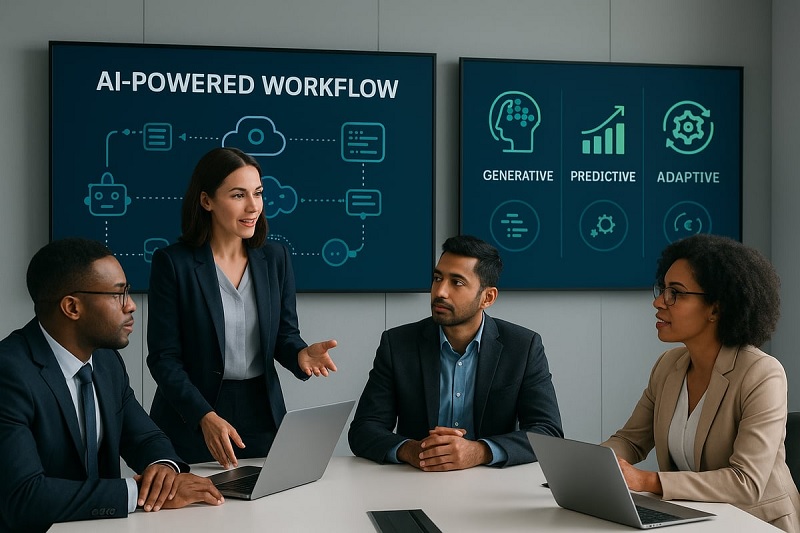

Corporate longevity is currently undergoing a brutal stress test. We have crossed the threshold where artificial intelligence is an experimental luxury; it is now the baseline infrastructure for survival. Managers clinging to manual processes and legacy software are not just slowing their companies down—they are actively engineering their own obsolescence. The choice facing executive leadership is stark but simple: automate the mundane or stagnate into irrelevance. To maintain a competitive edge, modern management must rapidly deploy AI across specific operational bottlenecks where human capital is currently being wasted.
The integration of artificial intelligence is no longer about replacing the workforce; it is about elevating it. When highly paid professionals spend their days routing emails, reconciling spreadsheets, and manually cross-referencing databases, a company is bleeding its most valuable resource: cognitive capital. The modern enterprise must fundamentally restructure its operations so that machines handle the execution of predictable tasks, leaving the humans to focus exclusively on strategy, empathy, and innovation.
The Illusion of Efficiency in Legacy Operations
For years, businesses have masked deep operational inefficiencies by simply throwing more bodies at a problem or buying another piece of disconnected software. This creates a massive accumulation of operational debt. Middle managers often mistake busyness for productivity, rewarding teams that spend sixty hours a week executing tasks that a properly trained algorithm could accomplish in seconds.
Traditional automation relied on rigid, rules-based programming. If a process deviated even slightly from the defined parameters, the system broke, and a human had to intervene. Modern AI, particularly generative AI and advanced machine learning models, is entirely different. It can parse unstructured data, understand context, and make probabilistic decisions. This means management can now automate complex, messy workflows that previously required a human touch, such as reading an angry customer email, determining the core issue, routing it to the correct department, and drafting a highly personalized response for the agent to review.
Talent Acquisition and the Evolution of Human Resources
The traditional hiring process is profoundly broken. It is a slow, biased, and highly administrative function that often fails to identify the best candidates. Recruiting teams spend the vast majority of their bandwidth manually scanning resumes and scheduling interviews, leaving little time for actual relationship building or strategic workforce planning.
Predictive Hiring and Skill Matching
By implementing AI at the top of the recruitment funnel, management can transform talent acquisition from a reactive scramble into a predictive science. Modern AI platforms do not simply match keywords on a resume; they analyze a candidate’s entire digital footprint, evaluate their problem-solving capabilities through gamified assessments, and predict their likelihood of long-term success based on the historical data of top performers within the company.
Furthermore, AI is revolutionizing internal mobility. Instead of losing talented employees to competitors because they feel stagnant, management can use AI to map the adjacent skills of their current workforce. The system can automatically identify an employee in customer support who possesses the exact analytical traits needed for an open role in product management, proactively suggesting a career pivot and generating a customized training curriculum to bridge the gap.
Hyper-Personalizing the Customer Experience at Scale
In a saturated market, customer experience is the only durable differentiator. However, delivering a highly personalized, white-glove experience to every single customer is mathematically impossible using human labor alone. The economics simply do not scale. AI solves this constraint by delivering hyper-personalization at an infinite scale.
Moving from Reactive Support to Predictive Resolution
The era of making a customer wait on hold for twenty minutes only to explain their problem to three different agents is over. Today, natural language processing models can serve as autonomous front-line agents that actually resolve issues, rather than just deflecting them with generic FAQ links. These AI systems integrate directly with a company’s backend infrastructure to process refunds, update shipping addresses, and troubleshoot complex technical issues in real-time, twenty-four hours a day.
More importantly, AI allows management to shift from reactive support to predictive resolution. By continuously analyzing product telemetry and user behavior, AI can identify exactly when a customer is experiencing friction. If a user is repeatedly failing to configure a software integration, the AI can proactively trigger an in-app message with a highly specific solution before the customer even submits a support ticket. This proactive intervention dramatically reduces churn and transforms the perception of the brand from a passive vendor to an active partner.
Supply Chain Resilience and Dynamic Inventory Management
Global supply chains are inherently fragile, built on decades of optimization for cost rather than resilience. When a pandemic, geopolitical conflict, or natural disaster disrupts a key logistics node, traditional inventory management systems fail catastrophically because they rely on historical data that is no longer relevant.
Management must implement AI to build dynamic, self-healing supply chains. Machine learning algorithms can ingest millions of data points simultaneously—including real-time weather patterns, port congestion metrics, raw material pricing, and global economic indicators—to forecast demand fluctuations with pinpoint accuracy. Instead of relying on a static quarterly forecast, AI continuously recalculates the optimal inventory levels for every warehouse. If the system detects a high probability of a supplier delay in one region, it can autonomously re-route raw materials from a secondary supplier to prevent a manufacturing bottleneck, completely bypassing human latency.
Continuous Financial Forecasting and Risk Mitigation
The traditional corporate budgeting process—a grueling, months-long exercise that results in a static financial plan—is dead on arrival in today’s volatile economy. By the time the board approves the annual budget, the market conditions have already shifted. Financial leadership must transition to continuous, AI-driven forecasting.
AI models can analyze total corporate spend, market trends, and historical revenue cycles to generate rolling forecasts that update daily. This gives the executive team an accurate, real-time pulse on cash flow and runway. Additionally, AI is the ultimate defense mechanism for risk mitigation and compliance. Machine learning algorithms excel at anomaly detection, scanning every single expense report, vendor invoice, and payroll transaction in real-time to flag potential fraud, duplicate payments, or compliance violations before the money ever leaves the company’s accounts.
Cultivating an AI-Ready Organizational Culture
The most significant barrier to AI implementation is not technical; it is cultural. If employees view artificial intelligence as a direct threat to their livelihood, they will actively resist its adoption, sabotage the data inputs, and cling to their manual workflows. The mandate for modern management is to orchestrate this transition with deep psychological insight.
Leadership must aggressively frame AI as a collaborative tool, an intellectual exoskeleton that amplifies human capability. This requires a fundamental shift in how performance is measured. If a manager continues to evaluate an employee based on the volume of emails they send or the number of reports they manually generate, they are incentivizing the wrong behavior. Key performance indicators must evolve to measure strategic output, creative problem-solving, and the ability to leverage AI to achieve faster results.
When management successfully abstracts away the soul-crushing, repetitive tasks of the daily grind, they unlock the true potential of their workforce. The organizations that embrace this shift will operate with a level of velocity and precision that legacy companies simply cannot match. AI is no longer a future state to prepare for; it is the present reality demanding immediate action.

Comments are closed.