
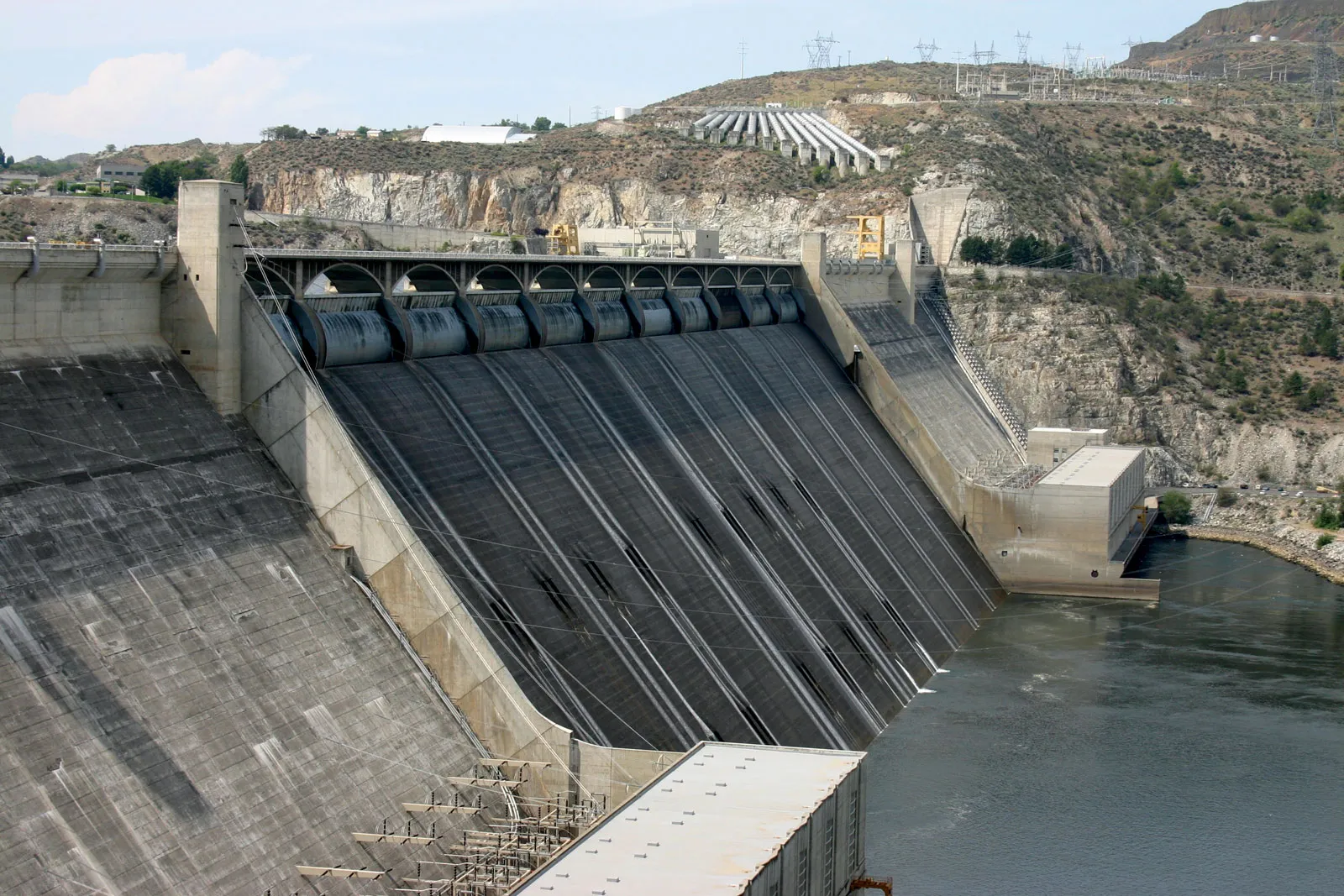

When engineers designed many of the dams operating across the United States today, they worked from the best hydrologic records, construction methods and analytical tools available to them. Those structures have since entered a world their original designers could not fully anticipate. Rainfall patterns have shifted. Watersheds have changed. Communities have grown downstream. Materials have aged, operating priorities have evolved and decades of inspections have produced records that do not always connect neatly with one another.
Civil and environmental engineering researcher Ebrahim Ahmadisharaf offers a useful way to understand what this means for the next generation of dam technology. Ahmadisharaf studies compound hydroclimatic extremes, flood risk and resilient water infrastructure at the FAMU-FSU College of Engineering. His recent work does not treat dam safety as a fixed calculation completed when a structure enters service. It asks how risk changes as the conditions surrounding a dam move away from the assumptions engineers used decades earlier.
“We have to plan upfront for this potential risk,” Ahmadisharaf said while discussing a 2025 study of changing overtopping probabilities at major U.S. dams. That sentence captures the central challenge. Engineers can no longer assume that a dam which satisfied earlier design criteria will face the same distribution of storms, reservoir levels and downstream consequences throughout its operating life. The future of dam technology will depend on giving owners better ways to recognize change before it becomes an emergency.
Sensors, digital twins, autonomous construction equipment, robotic inspections and artificial intelligence will all contribute. Yet the technology itself does not represent the most important development. The deeper shift involves moving from periodic observation toward continuous learning. Future dams will not simply hold water. Their monitoring and management systems will help engineers understand how each structure responds to changing loads, accumulating deterioration and increasingly complex environmental conditions.
The Problem with Treating the Past as a Permanent Design Standard
Engineers have traditionally relied on historical records to estimate how often a site might experience an extreme flood, water level or rainfall event. They use those probabilities to establish spillway requirements, reservoir operating rules and other safety criteria. This approach remains fundamental to water-resources engineering, but it becomes less reliable when the underlying climate and watershed no longer behave as they did during the period that produced the historical record.
Ahmadisharaf and his colleagues examined this problem by analyzing water-level records from 33 major U.S. dams. Each dam had at least 50 years of publicly available data. The researchers divided the records into rolling 30-year periods from 1973 through 2022 and recalculated overtopping probabilities for each period rather than treating the entire record as one unchanging statistical population.
Their results showed an overall increase in the number of dams falling within critical overtopping-probability categories and a decline in the number remaining in the lowest category. Twelve dams showed statistically significant trends, with six increasing and six decreasing. Four of the six dams with significant upward trends sat in the Southern Great Plains. The study also identified six large, high-hazard dams with the greatest overtopping probabilities among the structures analyzed.
The researchers did not claim that every dam faces the same trajectory or that climate alone explains each change. Their findings instead demonstrate why dam owners need to revisit risk periodically. A water-level record may show no obvious upward trend while the probability of reaching the dam crest still changes because the distribution and variability of extreme levels have shifted. Averages can remain deceptively calm while the tails of the distribution become more consequential.
This insight will influence future dam design, but it may matter even more for existing structures. Engineers will increasingly need to reassess spillway capacity, freeboard, outlet performance and emergency operating rules against updated hydrologic information. They will also need methods that distinguish a temporary fluctuation from a persistent change. Technology can help perform those analyses more frequently, but engineers must still determine what the results mean for a particular structure and community.
Dam Failures Show Why Better Information Matters
The history of dam failure does not point to one universal weakness. The Association of State Dam Safety Officials identifies overtopping, foundation defects, cracking, inadequate maintenance and internal erosion among the primary causes. Its national figures attribute approximately 34 percent of U.S. dam failures to overtopping, about 30 percent to foundation defects and roughly 20 percent to piping or internal erosion caused by uncontrolled seepage.
These categories often interact. A blocked or undersized spillway can raise the reservoir until water crosses an embankment. Seepage can slowly remove soil from within a structure before a sinkhole or muddy discharge makes the problem visible. Foundation movement can create cracks that provide new paths for water. Poor maintenance may allow a manageable defect to develop into a much larger condition.
Technology cannot remove these physical mechanisms. It can make them easier to detect, measure and interpret. A sensor network may identify rising pore pressure before the downstream slope shows distress. Repeated three-dimensional scans may reveal that a crack has widened by several millimeters rather than relying on photographs taken from different angles. A digital construction record may show which material and compaction history surround an area of unexpected settlement.
The future of dam safety will therefore depend less on finding one revolutionary device and more on connecting many forms of evidence. A successful monitoring system must help an engineer move from a signal to an explanation and then from an explanation to a proportionate response.
Intelligent Construction Will Record How a Dam Came Together
A dam’s future performance begins long before the reservoir fills. Earth and rockfill dams rise through repeated cycles of material placement, grading, moisture adjustment and compaction. Each layer must meet requirements for thickness, density, material distribution and other properties. Small variations can accumulate across an enormous structure, particularly when traditional quality-control methods test selected points rather than the full construction surface.
Researchers Yujie Wang, Yufei Zhao, Biao Liu, Naixin Wang and Chenfeng Li describe how intelligent construction systems could change this process. Their work examines the use of detailed building information models, rapid particle-size recognition, autonomous equipment and real-time compaction assessment in earth and rockfill dam construction. Instead of waiting for a later test to reveal a problem, these systems attempt to identify departures while crews can still correct them.
Positioning systems can record the path of each roller across a lift. Sensors can track speed, vibration and the number of passes completed over each section. Camera systems can estimate whether rockfill material matches the required gradation. A digital model can compare field activity with the design and highlight areas that require another pass or closer inspection.
The value extends beyond immediate quality control. An intelligent construction system can preserve a location-specific history of how crews built the dam. Decades later, an engineer investigating unexpected movement could examine the material source, lift thickness, compaction record and field observations associated with that particular zone.
This does not mean automated equipment should replace construction engineers or inspectors. Field conditions seldom behave as cleanly as a digital model expects. Material moisture changes, equipment encounters irregular ground and geological conditions surprise even experienced teams. Intelligent systems can document and compare the work at a scale people cannot achieve manually, while engineers judge when the data reflect a genuine problem and when conditions require a different interpretation.
The Dam That Remembers
Once construction ends, another challenge begins. Dam records often live in separate systems accumulated across generations. Engineers may need to consult original drawings, geological reports, inspection photographs, instrument databases, repair documents and spreadsheets maintained by different departments. Even when each source contains valuable information, the separation makes it difficult to see how one finding relates to another.
Evan Lindenbach, an engineer with the Bureau of Reclamation, leads research into a digital twin that couples building and geological models for a Reclamation dam. The project aims to incorporate concrete crack locations, piezometer readings, drain discharge and other structural-health information into an interactive model that also shows how conditions change with time. Reclamation intends the project to create a framework that other facilities can use rather than a one-off visualization.
A digital twin differs from a conventional three-dimensional model because it maintains a relationship with the physical structure. Engineers can add inspection findings, instrumentation readings, repairs and analytical results as the dam changes. Instead of opening several databases and trying to reconstruct the story manually, the team can examine information in its physical location and historical context.
The Bureau of Reclamation has described digital twins as spatially and temporally referenced databases that can reveal missing information, support dam-safety event trees, improve operations and maintenance planning and help teams assess proposed modifications. The U.S. Army Engineer Research and Development Center has developed a related framework that combines failure models, sensor data, structural-health monitoring and artificial intelligence to support rehabilitation decisions.
The most important contribution may involve institutional memory. Dams often remain in service longer than the careers of the people who design, operate and inspect them. When experienced staff retire, they take years of context with them. A well-maintained digital twin can preserve more than readings and images. It can retain the reasoning behind repairs, investigations and operating decisions so future engineers understand why earlier teams acted as they did.
A digital twin still cannot become an unquestioned source of truth. It will inherit errors, gaps and uncertainty from the records used to build it. Owners will need clear standards for data quality, version control and responsibility. A sophisticated model filled with unverified information may inspire more confidence than it deserves. Engineers must treat the twin as an organized body of evidence, not as an oracle.
Monitoring Will Move from Individual Readings to Connected Patterns
Dam instrumentation already measures seepage, water pressure, settlement, deformation, temperature and structural movement. The next step involves collecting denser information and interpreting relationships across multiple instruments.
Fiber-optic sensing provides one example. Engineers can install optical cable along a structure and measure strain, temperature or vibration at closely spaced intervals. Reclamation researchers have explored the technology for detecting internal erosion, leaks, breaches and other infrastructure conditions. Updated Reclamation design guidance describes systems that can provide deformation information at approximately one-meter intervals, giving engineers a more continuous view than widely separated instruments can offer.
A larger volume of measurements does not automatically produce a clearer conclusion. Reservoir elevation, rainfall, seasonal temperatures and operational changes can influence multiple instruments at once. A sensor may also drift, fail or respond to local conditions that do not represent the broader structure. Engineers need to distinguish a meaningful pattern from normal variability and bad data.
Machine-learning tools can help identify combinations that deserve attention. A system might flag a gradual increase in seepage when it coincides with rising pore pressure and localized surface movement. It could compare the current response with previous reservoir cycles or show that a relationship which once remained stable has started to change.
These systems should explain what prompted an alert. Dam safety professionals need the underlying measurements, comparisons and uncertainty, not a colored risk score with no visible reasoning. An interpretable alert allows an engineer to challenge the result, seek additional evidence and decide how urgently the condition requires action.
Robots Will Go Where Inspectors Should Not
Some of the most important parts of a dam occupy places that people cannot inspect easily or safely. Outlet conduits can involve confined spaces, flowing water, debris and deteriorated components. Steep faces and submerged structures create different hazards. Owners sometimes postpone close examination because inspection requires shutdowns, specialized access or significant safety precautions.
The U.S. Army Engineer Research and Development Center developed DamBot to help inspect earth-dam outlet works remotely. The robotic platform can transmit a 360-degree video stream and generate a detailed three-dimensional map as it moves through a conduit. Engineers can compare later surveys with the earlier model and examine changes without sending personnel into the structure for the initial assessment.
Drones can play a similar role on exposed surfaces. Repeat flights can photograph a concrete face, spillway or embankment from consistent locations. Photogrammetry software can turn those images into a measurable model, allowing teams to compare cracking, erosion or displacement across inspection periods.
Robotics will not eliminate the engineer’s physical encounter with the structure. A camera cannot always determine the depth of a defect, the condition beneath a stain or the cause of a sound. Remote tools can conduct broad surveys, identify areas of concern and reduce unnecessary exposure. Engineers can then direct close inspection toward the locations where human judgment and specialized testing matter most.
The Most Dangerous Storm May Begin Weeks Before Failure
Research by Jeongwoo Hwang and Upmanu Lall adds another important dimension to Ahmadisharaf’s argument. They analyzed precipitation associated with 552 hydrologically induced dam failures in the United States. In many cases, the maximum one-day rainfall near the time of failure did not qualify as exceptionally rare when considered alone. The unusual condition emerged when the researchers combined that event with the rainfall accumulated during the preceding five to 30 days.
A watershed carries memory. Repeated storms can saturate soil, fill tributaries and raise reservoir levels before the final event arrives. The last storm may look moderate according to traditional single-event statistics, yet it falls on a system that has little remaining capacity.
This insight challenges a familiar habit in infrastructure planning. Engineers often communicate flood risk through a single design event, such as a storm with a specified return period. Future hydrologic tools will need to examine event sequences, antecedent moisture, reservoir operations and watershed response together. Forecasting systems may need to recognize when several unremarkable storms have created an exceptional cumulative condition.
The same principle applies to operations. A digital model could test reservoir releases against several forecast scenarios, downstream channel conditions and the uncertainty in expected inflow. Operators could evaluate an early drawdown before the reservoir approaches a critical level. The system would inform the decision, while people remain responsible for balancing flood risk, water supply, environmental flows and downstream safety.
Rehabilitation Will Drive Much of the Innovation
The phrase “future dam technology” may evoke new megaprojects, but much of the most consequential work will occur at existing dams. Owners must decide where to repair spillways, improve drainage, add instrumentation, replace gates, strengthen embankments or revise operating procedures. Some structures will require major rehabilitation. Others may no longer provide enough benefit to justify continued maintenance and risk.
Digital twins, remote inspections and risk models can help owners compare needs across a portfolio. A structure with accelerating seepage, limited spillway capacity and a growing downstream population may warrant attention before a dam with visible but stable surface deterioration. Technology can organize the evidence, run scenarios and reveal how uncertainty changes the ranking.
Yet prioritization contains values as well as calculations. A model may estimate the likelihood of failure and the potential inundation area, but public agencies and owners must decide how to weigh human safety, environmental damage, economic disruption, cultural resources and unequal effects on downstream communities.
Ahmadisharaf’s call to “plan upfront” therefore reaches beyond hydrology. It asks engineers and owners to act while they still have choices. Emergency planning, monitoring improvements and targeted rehabilitation cost money, but failure removes the luxury of choosing the timing or scale of the response.
Artificial Intelligence Will Advise, Not Assume Responsibility
Artificial intelligence can review large image collections, compare decades of sensor readings and run more simulations than an engineering team could examine manually. It can identify anomalies, rank inspection priorities and search for relationships that fixed alarm thresholds may miss.
It cannot accept professional responsibility for the result.
Dam safety decisions involve incomplete information, uncertain forecasts, malfunctioning equipment and consequences that extend far beyond the structure. An algorithm trained on previous behavior may struggle with a condition that has no close historical comparison. A model may also produce a convincing answer from missing, biased or poorly maintained data.
Future systems will need transparent assumptions, clear uncertainty ranges and manual fallback procedures. Engineers should know which observations drove a recommendation and how sensitive the result remains to missing information. Cybersecurity will also become a central safety concern as monitoring, modeling and control systems grow more connected.
The goal should not involve creating a dam that operates without people. It should involve giving engineers a longer field of vision. Technology can notice subtle changes, preserve institutional knowledge and test alternatives quickly. People must determine which evidence deserves trust, which tradeoffs remain acceptable and when the situation requires action.
A Familiar Structure with a New Nervous System
The dam of the future may not look dramatically different from the dam of the past. An earthfill embankment will still rely on carefully selected and compacted material. A concrete gravity dam will still resist the reservoir through its mass and foundation. Spillways, gates, drains and outlets will continue to perform recognizable physical functions.
The transformation will happen in the information surrounding those components. Construction equipment may record the history of every lift. Fiber-optic cables may watch for localized strain or temperature changes. Robots may map conduits that once received only occasional inspection. Digital twins may connect geologic conditions, instrument data, repairs and operational decisions across decades. Hydrologic models may track sequences of storms rather than waiting for one dramatic event.
Ahmadisharaf’s research gives these technologies a common purpose. They should help engineers recognize when the present has separated from the past. A dam does not become unsafe merely because it has aged, and a new tool does not make it safe merely because it produces more data. Safety depends on how well engineers understand changing conditions and how early owners act on that understanding.
The most advanced dam will not necessarily carry the largest sensor network or the most elaborate digital model. It will give its operators a clearer account of what has changed, why that change matters and what they can still do about it.

Comments are closed.