
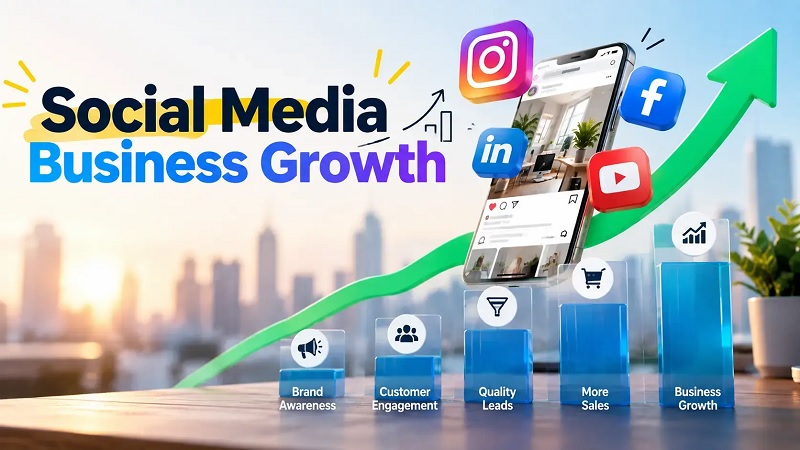

Social media advertising is no longer a peripheral marketing tactic or an experimental budget line item. It has evolved into the central nervous system of modern consumer commerce. In a landscape where attention is the most valuable currency, platforms that command hours of daily user engagement have seamlessly transformed into the world’s most efficient marketplaces. The relationship between a brand and a consumer is now instantaneous, deeply personal, and highly measurable. Understanding how paid social strategies influence both initial engagement and final sales is essential for any modern business looking to scale.
Moving Beyond the Billboard: The Evolution of Customer Engagement
Traditional advertising operated on a broadcast model. Brands pushed a single message out to a broad audience and hoped for the best, relying on the sheer volume of impressions to generate a fraction of a percent in conversions. Social media flipped this dynamic entirely, introducing the concept of conversational commerce.
Today, customer engagement is not passive observation; it is an active feedback loop. When a user interacts with a social media advertisement, they are actively shaping their own digital experience. Every like, share, save, and comment sends a signal to the underlying algorithm, refining the user’s profile and pulling them deeper into the brand’s orbit. This bidirectional communication builds a sense of community and trust that traditional media could never achieve. By inviting the consumer to participate in the narrative, brands transform passive viewers into active stakeholders in the company’s success.
Decoding the Engagement Matrix: How Hyper-Targeting Works
The true leverage of social media advertising lies in its unprecedented capacity for hyper-targeting. Advertisers are no longer guessing who might want their product based on broad demographic buckets. Instead, they are utilizing thousands of data points to identify precise behavioral patterns, interests, and purchase intents.
The Psychology of Personalization
Personalization drives engagement because it taps into the fundamental human desire to feel understood. When an advertisement perfectly aligns with a user’s current problem, aesthetic preference, or recent browsing history, it bypasses the typical skepticism associated with outbound marketing. Instead of feeling like an intrusion, a highly targeted social media ad feels like a timely recommendation from a knowledgeable friend.
This psychological alignment drastically increases engagement rates. Users stop scrolling because the content resonates with their immediate reality. Whether it is an ad for running shoes shown to someone who just downloaded a marathon training app, or B2B software presented to an entrepreneur searching for productivity tools, relevance is the ultimate driver of interaction.
Lookalike Audiences and Algorithmic Expansion
Beyond targeting known customers, social platforms excel at predictive matchmaking through lookalike audiences. By analyzing the traits of a brand’s most valuable existing buyers, algorithms can scour millions of user profiles to find new individuals who share identical digital fingerprints. This means businesses can scale their reach while maintaining the high engagement rates typically reserved for warm leads, effectively introducing their products to a highly receptive, pre-qualified audience.
Collapsing the Funnel: From Discovery to Direct Sales
Historically, the marketing funnel was a long, fragmented journey. A consumer might see a television commercial, remember the brand a week later while at a store, and finally make a purchase. Social media advertising has completely collapsed this funnel, shrinking the distance between product discovery and checkout to a matter of seconds.
Frictionless Checkout and Shoppable Formats
The integration of native commerce features directly into social media platforms has revolutionized the sales cycle. Shoppable posts, augmented reality try-ons, and in-app storefronts allow consumers to act on their buying impulses immediately. By removing the friction of navigating away from the app, creating a new account, or entering credit card details on a clunky mobile website, social media advertising capitalizes on high-intent moments before they fade.
When a user sees a compelling video demonstrating a product, they do not need to hunt for it on a search engine. A single tap on the product tag opens a secure checkout interface. This frictionless environment is arguably the most significant factor in how social media advertising directly accelerates sales volume.
The Multiplier Effect of Social Proof
Advertising in a social environment inherently benefits from the psychology of social proof. A standalone advertisement on a website exists in a vacuum. The exact same advertisement on a social media feed is surrounded by contextual validation.
When users see an ad that has accumulated thousands of likes, hundreds of positive comments, and shares from people within their extended network, the perceived risk of purchasing drops significantly. The engagement itself becomes a secondary advertisement. Brands that actively cultivate comment sections on their paid posts, responding to questions and resolving concerns in real-time, leverage this engagement to build rapid trust. This public display of customer service and community approval serves as a powerful catalyst for sales, convincing hesitant buyers to finalize their purchases.
Strategic Retargeting: Capturing the Abandoned Intent
Even with the most compelling creative and seamless checkout process, most consumers will not purchase on the first interaction. Modern buying behavior is non-linear. Users get distracted, they want to compare prices, or they simply prefer to wait until payday. This is where strategic retargeting transforms lost opportunities into recovered revenue.
Retargeting utilizes tracking pixels and server-side APIs to identify users who engaged with an ad, watched a specific percentage of a video, or abandoned a shopping cart. By serving a sequential series of advertisements to these specific individuals, brands can stay top-of-mind. The brilliance of social media retargeting is that the creative can change based on the user’s specific stage in the buying journey. An initial ad might focus on brand storytelling, while a retargeting ad might offer a time-sensitive discount code, display customer testimonials, or highlight the specific product the user left in their cart. This sustained, intelligent presence significantly lifts conversion rates and overall sales.
Measuring the Unseen: Advanced Analytics and Attribution
The impact of social media advertising on sales is not left to assumption; it is rigorously quantified. The depth of analytics available allows brands to trace a direct line from ad spend to revenue generated.
To truly understand performance, sophisticated marketers look beyond surface-level vanity metrics like impressions or basic click-through rates. Return on Ad Spend (ROAS) and Customer Acquisition Cost (CAC) are the definitive indicators of advertising health. Furthermore, platforms now offer incrementality testing, which helps businesses measure the true causal impact of their ads by comparing a targeted group against a control group that saw no advertising. This rigorous data analysis ensures that marketing budgets are continuously optimized, shifting funds away from underperforming assets and pouring fuel on the campaigns that are actively driving bottom-line growth.
What Lies Ahead: AI and the Next Era of Social Advertising
The landscape of customer engagement is currently undergoing another massive shift driven by artificial intelligence. Generative AI is beginning to automate the creation of ad copy and visual assets, allowing brands to test thousands of variations in real-time to see which combinations yield the highest engagement.
More importantly, AI is enhancing predictive targeting. Future algorithms will not just react to what users have done; they will accurately predict what users will need before the users themselves even realize it. Advertising will become entirely fluid, morphing in format, tone, and timing to perfectly suit the individual viewer. As social media platforms become smarter, the advertising ecosystem within them will only become more effective at turning casual scrollers into loyal, high-value customers.
Ultimately, social media advertising has fundamentally rewritten the rules of commerce. It has blurred the lines between entertainment, community building, and transactional retail. For brands willing to invest in high-quality creative, rigorous testing, and strategic data analysis, social platforms offer an unparalleled engine for scalable, predictable growth.

Comments are closed.